第 1 單元,第 1 課
Earth's Motion Around the Sun地球繞日運動
這課一眼看
Earth’s motions地球的運動
- rotation axis自轉軸: The line on which an object rotates.
- rotation自轉: Spinning motion of an object on its axis.
- apparent motion視運動: Motion of objects in the sky that appears to happen because Earth rotates.
- orbit軌道: Path an object follows as it moves around another object.
- revolution公轉: Motion of one object around another.
- gravity重力(萬有引力): Attractive force between all objects that have mass.
Seasons季節
- solstice至日(夏至、冬至): Day when Earth’s axis is tilted most toward or away from the Sun.
- equinox分點(春分、秋分): Day when Earth’s axis leans neither toward nor away from the Sun.
1Earth’s motions地球的運動
ARotation自轉
- Earth spins on an imaginary line through its center called its rotation axis. This spinning is rotation. Seen from above the North Pole, Earth rotates counterclockwise, from west to east, once about every 24 hours, causing day and night.地球繞著穿過中心的一條假想線旋轉,這條線稱為自轉軸,這種旋轉稱為自轉。從北極上方看,地球由西向東逆時針自轉,約每 24 小時一圈,造成晝夜。
- Because Earth rotates west to east, the Sun, Moon, and stars appear to move east to west across the sky. This apparent motion is like people on the ground seeming to move backward when you ride a merry-go-round.因為地球由西向東自轉,太陽、月亮和星星看起來由東向西移動。這種視運動就像坐旋轉木馬時,地面上的人看起來往反方向移動。
BRevolution and orbit公轉與軌道
- The path an object follows around another object is its orbit. The motion of one object around another is revolution. Earth completes one revolution around the Sun every 365.24 days in a nearly circular orbit.一個物體繞另一個物體運行的路徑稱為軌道。一個物體繞另一個物體的運動稱為公轉。地球沿著近乎圓形的軌道繞太陽公轉一圈需要 365.24 天。
- The Sun’s gravity keeps Earth in orbit, like a string keeping a twirled ball moving in a circle. If gravity stopped, Earth would fly off in a straight line. Gravity between two objects is stronger when they have more mass or are closer together.太陽的重力讓地球保持在軌道上,就像繩子讓甩動的球繞圈。如果重力消失,地球會沿直線飛出去。兩個物體質量越大、距離越近,彼此的重力越強。
2Why it is warmer at the equator為什麼赤道比較熱
ACurved surface spreads sunlight曲面讓陽光分散
- Because Earth’s surface is curved, sunlight strikes the equator almost head-on but strikes areas near the poles at a low angle. The same beam of light spreads over a larger area near the poles, so each square meter gets less energy. That is why the poles are colder.因為地表是彎曲的,陽光幾乎直射赤道,卻以低角度斜射兩極附近。同樣一束光在兩極附近分散到較大面積,每平方公尺得到的能量較少,所以兩極較冷。
3Seasons季節
AThe tilted axis causes seasons地軸傾斜造成季節
- Earth’s rotation axis is tilted, and it always points the same direction in space. For half of the orbit, the north end tilts toward the Sun; for the other half, it tilts away. The hemisphere tilted toward the Sun gets more direct sunlight and longer days, so it has summer.地球的自轉軸是傾斜的,而且在太空中永遠指向同一方向。公轉的一半時間,北端傾向太陽;另一半時間,北端背離太陽。傾向太陽的半球得到較直射的陽光和較長的白天,就是夏季。
- Seasons are not caused by distance from the Sun. Earth is actually closest to the Sun (perihelion, about 147 million km) in early January, during northern winter, and farthest (aphelion, about 152 million km) in early July.季節不是由地球和太陽的距離造成的。地球其實在一月初(北半球冬季)最接近太陽(近日點,約 1.47 億公里),在七月初最遠(遠日點,約 1.52 億公里)。
BSolstices and equinoxes至日與分點
- A solstice is a day when Earth’s axis tilts most toward or away from the Sun. An equinox is a day when the axis leans along the orbit, neither toward nor away from the Sun, so day and night are about 12 hours everywhere.至日是地軸最傾向或最背離太陽的那一天。分點(春分、秋分)是地軸沿著軌道方向、既不傾向也不背離太陽的那一天,全球晝夜各約 12 小時。
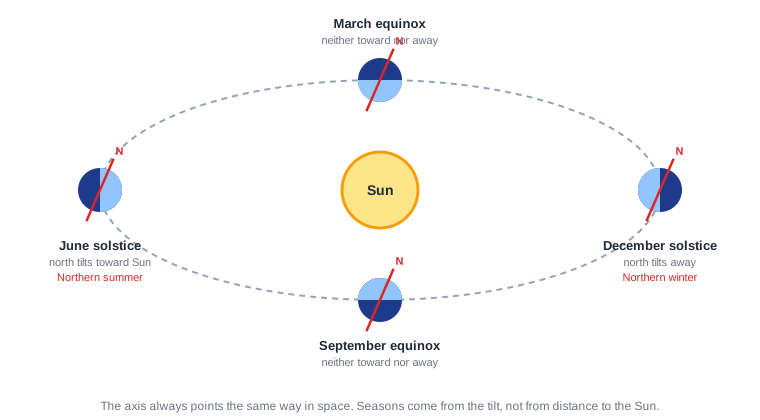
Seasons in the Northern Hemisphere北半球的季節
| Date (approx.)日期(約) | Event事件 | North end of axis地軸北端 | Daylight in north北半球白晝 |
|---|---|---|---|
| June 216 月 21 日 | June solstice (summer begins)夏至(夏季開始) | Most toward the Sun最朝向太陽 | Longest day白晝最長 |
| September 229 月 22 日 | September equinox (fall begins)秋分(秋季開始) | Along the orbit沿著公轉軌道方向 | About 12 hours約 12 小時 |
| December 2212 月 22 日 | December solstice (winter begins)冬至(冬季開始) | Most away from the Sun最背向太陽 | Shortest day白晝最短 |
| March 213 月 21 日 | March equinox (spring begins)春分(春季開始) | Along the orbit沿著公轉軌道方向 | About 12 hours約 12 小時 |
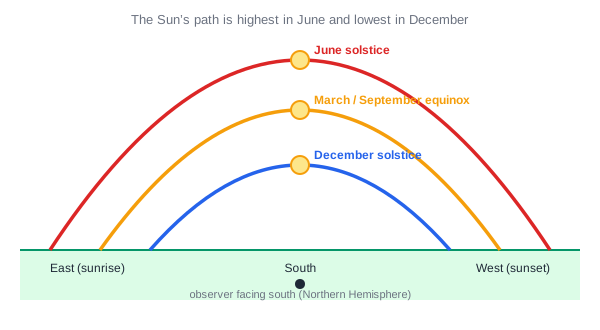
- In the Northern Hemisphere the Sun’s path across the sky is highest at the June solstice and lowest at the December solstice. Near the poles, the tilt causes polar night and midnight sun: months when the Sun never rises or never sets.在北半球,太陽在天空中的路徑在夏至最高、冬至最低。在極區,地軸傾斜造成永夜和永晝:連續好幾個月太陽不升起或不落下。
注意
Meteorologists use meteorological seasons that follow calendar months (e.g., winter = Dec–Feb) because they are easier to compare from year to year than astronomical seasons.氣象學家使用依照月份劃分的氣象季節(例如冬季=12~2 月),因為比天文季節更方便逐年比較。
自我檢查
If Earth’s axis had no tilt, would there be seasons? Explain.如果地軸完全不傾斜,還會有季節嗎?請說明。
看答案
No (or almost none). Each place would get the same angle of sunlight and the same day length all year, so temperatures would hardly change through the year.不會(或幾乎沒有)。每個地方一年到頭陽光照射角度和白天長度都一樣,所以全年溫度幾乎不變。
這課的重點字
- rotation axis自轉軸
- rotation自轉
- apparent motion視運動
- orbit軌道
- revolution公轉
- gravity重力(萬有引力)
- solstice至日(夏至、冬至)
- equinox分點(春分、秋分)