第 1 單元,第 1 課
Energy and States of Matter能量與物質三態
這課一眼看
Solids, liquids, and gases固體、液體與氣體
- solid固體: Definite shape and definite volume.
- liquid液體: Definite volume; takes the shape of its container.
- gas氣體: No definite shape or volume; fills its container.
- compress壓縮: Squeeze into a smaller volume.
- fluid流體: Matter that can flow: a liquid or a gas.
Energy of particles粒子的能量
- kinetic energy動能: Energy due to motion.
- temperature溫度: Average kinetic energy of the particles.
- absolute zero絕對零度: 0 K, where particles would stop moving.
- potential energy位能: Stored energy from the positions of particles.
- thermal energy熱能: Total kinetic and potential energy of all particles.
Atoms, elements, and compounds原子、元素與化合物
- atom原子: Tiny particle that is the building block of matter.
- substance純物質: Matter whose composition is always the same.
- element元素: Substance made of only one type of atom.
- compound化合物: Two or more different elements bonded together.
- element ratio元素比例: Fixed ratio of atoms in a compound.
- periodic table週期表: Chart listing all elements and their symbols.
- chemical formula化學式: Symbols and numbers showing a compound’s atoms.
- subscript下標: Small number showing how many atoms of an element.
1Solids, liquids, and gases固體、液體與氣體
AShape and volume of each state各狀態的形狀與體積
- All matter is made of tiny particles. The three common states of matter are solid, liquid, and gas.所有物質都由微小的粒子組成。常見的三種物質狀態是固體、液體和氣體。
- A solid has a definite shape and a definite volume. A liquid has a definite volume but takes the shape of its container. A gas has neither a definite shape nor a definite volume; it spreads out to fill its container.固體有固定的形狀和固定的體積。液體有固定的體積,但形狀會隨容器改變。氣體沒有固定的形狀也沒有固定的體積,會擴散充滿整個容器。
- Solids and liquids are hard to compress. Gases are easy to compress because their particles are far apart. Liquids and gases can flow, so both are called fluids.固體和液體很難被壓縮。氣體容易被壓縮,因為氣體粒子之間的距離很大。液體和氣體都能流動,所以兩者合稱為流體。
Comparing the three states of matter三態比較
| Solid固體 | Liquid液體 | Gas氣體 | |
|---|---|---|---|
| Shape形狀 | Definite固定 | Takes container’s shape隨容器改變 | Takes container’s shape隨容器改變 |
| Volume體積 | Definite固定 | Definite固定 | Fills container充滿容器 |
| Can flow?能流動嗎? | No不能 | Yes能 | Yes能 |
| Easy to compress?容易壓縮嗎? | No不容易 | No不容易 | Yes容易 |
| Particle spacing粒子間距 | Very close, fixed非常近、固定 | Close近 | Far apart很遠 |
| Particle motion粒子運動 | Vibrate in place在原位振動 | Slide past each other彼此滑動 | Move fast, randomly快速、隨機移動 |
| Potential energy位能 | Lowest最低 | Middle中等 | Highest最高 |
BHow particles move in each state各狀態中粒子的運動
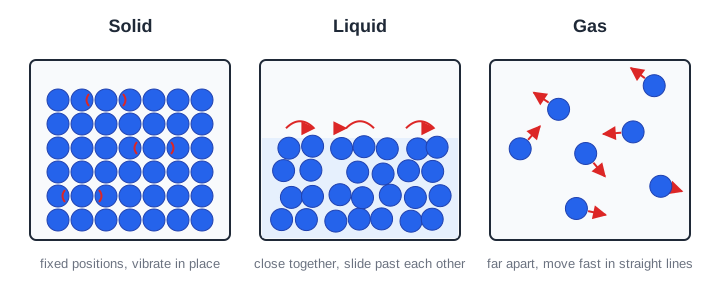
- In a solid, particles are packed closely in a fixed arrangement and only vibrate in place.固體中的粒子緊密排列、位置固定,只能在原地振動。
- In a liquid, particles are still close together, but they can slide past each other and move around randomly.液體中的粒子仍然靠得很近,但可以彼此滑過、隨機移動。
- In a gas, particles are widely spaced and move quickly in straight lines until they collide with another particle or the container wall.氣體中的粒子相距很遠,快速直線運動,直到撞上其他粒子或容器壁。
自我檢查
Is a substance a solid or a gas because of the size of its particles?物質是固體還是氣體,是因為粒子的大小嗎?
看答案
No. The particles of a substance are the same size in every state. What changes is how far apart they are and how fast they move.不是。同一種物質在三態中的粒子大小都一樣,改變的是粒子之間的距離和運動的快慢。
2Energy of particles粒子的能量
AKinetic energy and temperature動能與溫度
- Particles are always moving. The energy an object has because of its motion is kinetic energy. The faster particles move, the more kinetic energy they have.粒子一直在運動。物體因為運動而具有的能量稱為動能。粒子運動越快,動能越大。
- Temperature measures the average kinetic energy of the particles in a material. Heating a substance makes its particles move faster, so its temperature rises.溫度是物質中粒子平均動能的量度。加熱物質會使粒子運動加快,溫度因此上升。
- Temperature is measured with a thermometer on the Celsius, Fahrenheit, or Kelvin scale. Scientists usually use Celsius. On the Kelvin scale, 0 K is absolute zero, the temperature at which particles would have no motion at all. No material has ever been cooled to exactly 0 K.溫度用溫度計測量,單位有攝氏、華氏和克氏(絕對溫標)。科學家通常使用攝氏。克氏溫標的 0 K 稱為絕對零度,是粒子完全停止運動時的溫度。至今沒有任何物質被冷卻到正好 0 K。
注意
0 K = −273 °C. To change °C to K, add 273.0 K = −273 °C。攝氏溫度加 273 就是克氏溫度。
BPotential energy and thermal energy位能與熱能
- Particles that are close together attract each other. Potential energy is stored energy that comes from the positions of particles relative to each other. The farther apart particles are, the more potential energy they have.彼此靠近的粒子會互相吸引。位能是因粒子之間的相對位置而儲存的能量。粒子相距越遠,位能越大。
- Solid particles are closest and attract each other most strongly, so a solid has the least potential energy. Gas particles are farthest apart, so a gas has the most potential energy.固體粒子靠得最近、吸引力最強,所以固體的位能最小。氣體粒子相距最遠,所以氣體的位能最大。
- Thermal energy is the total kinetic and potential energy of all the particles in a sample. It depends on the temperature, the state of matter, the type of particles, and the amount of matter. A bathtub of water at 20 °C has more thermal energy than a glass of water at 20 °C because it has more particles.熱能是一個樣品中所有粒子的動能與位能的總和。它取決於溫度、物質的狀態、粒子的種類以及物質的量。一浴缸 20 °C 的水比一杯 20 °C 的水有更多熱能,因為浴缸的水粒子比較多。
自我檢查
Do an ice cube at 0 °C and the water it just melted into (also 0 °C) have the same energy?0 °C 的冰塊和剛融化成的 0 °C 水,能量一樣嗎?
看答案
No. They have the same temperature, but the liquid water has more potential energy because its particles are farther apart. So the water has more thermal energy.不一樣。兩者溫度相同,但液態水的粒子相距較遠,位能較大,所以水的熱能比較多。
3Atoms, elements, and compounds原子、元素與化合物
AAtoms, substances, and elements原子、純物質與元素
- An atom is a tiny particle that is the building block of all matter. Atoms combine in different ways to make the different kinds of matter around us.原子是組成所有物質的微小粒子,是物質的基本單位。原子以不同方式結合,形成我們周遭各種不同的物質。
- A substance is matter whose composition is always the same. Each substance has its own properties, such as its melting point and boiling point.純物質是組成永遠相同的物質。每一種純物質都有自己的性質,例如熔點和沸點。
- An element is a substance made of only one type of atom, such as helium, carbon, or oxygen. Elements can be solids, liquids, or gases.元素是只由一種原子組成的純物質,例如氦、碳、氧。元素可以是固體、液體或氣體。
BCompounds and element ratios化合物與元素比例
- A compound is a substance made of atoms of two or more different elements bonded together. A compound has different properties from the elements that make it up.化合物是由兩種或以上不同元素的原子鍵結在一起形成的純物質。化合物的性質和組成它的元素不同。
- When water is broken apart with electricity, it produces twice as much hydrogen gas as oxygen gas. This shows that water has 2 hydrogen atoms for every 1 oxygen atom.用電把水分解時,產生的氫氣是氧氣的兩倍。這表示水中每 1 個氧原子搭配 2 個氫原子。
- Every compound has a fixed element ratio. No matter how big the sample is, the ratio of atoms stays the same. The same elements in a different ratio make a different compound: nitrous oxide (2 N : 1 O) and dinitrogen trioxide (2 N : 3 O) are both made of nitrogen and oxygen but are different substances.每一種化合物都有固定的元素比例。不論樣品多大,原子的比例都不變。相同元素以不同比例結合,就是不同的化合物:一氧化二氮(2 N : 1 O)和三氧化二氮(2 N : 3 O)都由氮和氧組成,卻是不同的物質。
CChemical symbols and formulas化學符號與化學式
- Each element has a symbol of one or two letters, shown on the periodic table. The first letter is capital and the second is lowercase, for example H (hydrogen), Mg (magnesium), and Au (gold).每一種元素都有一或兩個字母組成的符號,列在週期表上。第一個字母大寫、第二個字母小寫,例如 H(氫)、Mg(鎂)、Au(金)。
- A chemical formula uses element symbols and numbers to show which elements are in a compound and the ratio of their atoms. In CO₂, the small number 2 is a subscript that means two oxygen atoms. A symbol with no subscript means one atom.化學式用元素符號和數字表示化合物中有哪些元素,以及原子的比例。CO₂ 中的小數字 2 是下標,代表兩個氧原子。沒有下標的符號代表一個原子。
Reading chemical formulas看懂化學式
| Formula化學式 | Name名稱 | Atoms in one molecule一個分子中的原子 | Ratio比例 |
|---|---|---|---|
| H₂OH₂O | water水 | 2 H, 1 O2 個 H、1 個 O | 2 : 12 : 1 |
| CO₂CO₂ | carbon dioxide二氧化碳 | 1 C, 2 O1 個 C、2 個 O | 1 : 21 : 2 |
| COCO | carbon monoxide一氧化碳 | 1 C, 1 O1 個 C、1 個 O | 1 : 11 : 1 |
| N₂ON₂O | nitrous oxide一氧化二氮 | 2 N, 1 O2 個 N、1 個 O | 2 : 12 : 1 |
| N₂O₃N₂O₃ | dinitrogen trioxide三氧化二氮 | 2 N, 3 O2 個 N、3 個 O | 2 : 32 : 3 |
這課的重點字
- solid固體
- liquid液體
- gas氣體
- compress壓縮
- fluid流體
- kinetic energy動能
- temperature溫度
- absolute zero絕對零度