第 1 單元,第 1 課
Human Population Growth人口成長
這課一眼看
How the human population has changed人口如何改變
- population族群(人口): All the members of a species living in a given area.
Population structure人口結構
- immigration移入: Moving into an area to live there.
- emigration移出: Leaving an area to settle somewhere else.
- age structure年齡結構: Number of males and females in each age group of a population.
Population and resources人口與資源
- carrying capacity負載量: Largest number of individuals of a species that resources can support for a long time.
1How the human population has changed人口如何改變
APopulation explosion人口爆炸
- A population is all the members of one species living in a given area. For most of history the human population grew slowly: about 300 million people a thousand years ago. Starting in the 1800s it rose sharply, to more than 7.6 billion today, and it may reach about 9.8 billion by 2050.族群(人口)是生活在某個區域內同一物種的所有成員。在大部分歷史中,人口成長很慢:一千年前約 3 億人。從 1800 年代開始急遽上升,現在超過 76 億,到 2050 年可能達到約 98 億。
- Improved health care, clean water, sanitation, and other technology mean more people live longer and have children. About 15,000 babies are born worldwide every hour.醫療進步、乾淨的水、衛生設施和其他科技,讓更多人活得更久、生育後代。全世界每小時約有 15,000 個嬰兒出生。
2Population structure人口結構
AWhat changes a population什麼改變人口
- A population grows when more individuals enter than leave. People enter by birth or immigration (moving into an area) and leave by death or emigration (moving out to live somewhere else).進入的人比離開的人多,人口就會成長。人以出生或移入(遷入某地居住)的方式進入族群,以死亡或移出(離開到別處居住)的方式離開。
- Population growth rate (%) = (birth rate − death rate + net migration rate) ÷ 10, when rates are given per 1,000 people. In 2015 Nigeria’s birth rate was 39 and death rate 14, giving about 2.5%; Germany’s was 8 and 11 with net migration of 5, about 0.2%.當出生率、死亡率以每千人計時,人口成長率(%)=(出生率 − 死亡率 + 淨遷移率)÷ 10。2015 年奈及利亞出生率 39、死亡率 14,成長率約 2.5%;德國出生率 8、死亡率 11、淨遷移 5,成長率約 0.2%。
BAge structure年齡結構
- A population’s age structure is the number of males and females in the pre-reproductive, reproductive, and post-reproductive age groups. It is drawn as an age structure diagram.人口的年齡結構是生殖前期、生殖期和生殖後期各年齡層的男女人數,用年齡結構圖(人口金字塔)表示。
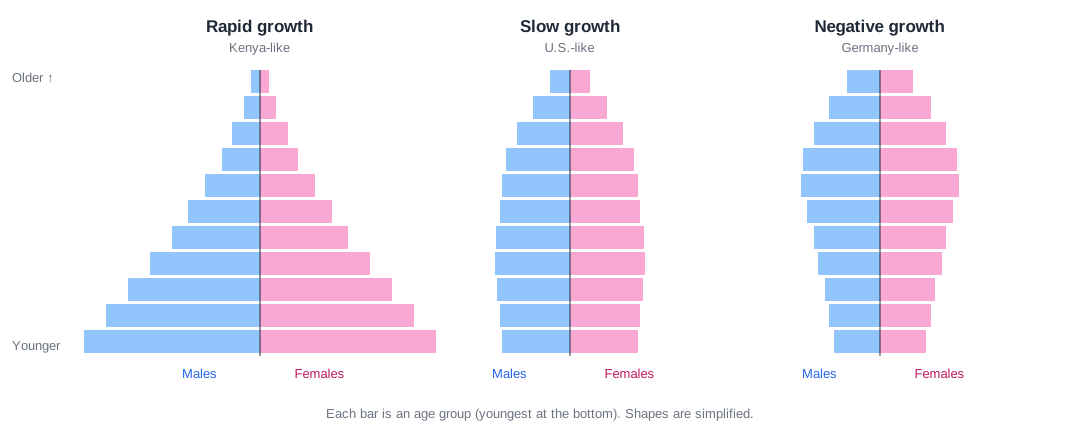
Age structure diagrams年齡結構圖
| Shape形狀 | Growth成長 | Example例子 |
|---|---|---|
| Triangle (wide base)三角形(底部寬) | Rapid growth快速成長 | Kenya肯亞 |
| Rectangle with a bulge in the middle長方形中間略凸 | Slow growth緩慢成長 | United States美國 |
| Narrow base, wider middle/top底部窄、中上部較寬 | Negative growth負成長 | Germany德國 |
自我檢查
An age structure diagram is wide at the bottom and narrow at the top. Will this population grow quickly or slowly? Why?一張年齡結構圖底部很寬、頂部很窄。這個人口會快速還是緩慢成長?為什麼?
看答案
Quickly. Many young people will soon reach reproductive age and have children.快速成長。很多年輕人很快就會進入生育年齡並生下後代。
注意
Sea otters off central California were hunted down to about 50 animals by the 1930s. Protection under the Marine Mammal Protection Act let the population recover.加州中部的海獺在 1930 年代被獵捕到只剩約 50 隻。受到《海洋哺乳動物保護法》保護後,族群逐漸恢復。
3Population and resources人口與資源
ACarrying capacity負載量
- Every person needs food, water, shelter, clothing, and energy, all from Earth’s natural resources. As population grows, resource use grows too.每個人都需要食物、水、住所、衣物和能源,這些都來自地球的自然資源。人口成長時,資源的使用量也跟著成長。
- carrying capacity is the largest number of individuals of a species that Earth’s resources can support for a long time. A population below carrying capacity has plenty of resources; one near or above it faces shortages and environmental damage and may decline.負載量是地球資源能長期支持的某物種最大個體數。低於負載量時資源充足;接近或超過負載量時就會資源短缺、環境受損,族群可能減少。
- New technologies and alternative resources can expand carrying capacity, but at a cost to Earth’s systems.新科技和替代資源可以提高負載量,但會對地球系統造成代價。
BPer-capita consumption人均消耗
- Impact depends on both how many people there are and how much each person uses. People in industrially developed countries such as the United States use far more resources per person than people in developing countries such as India or Nigeria.人類的影響取決於人口數量,也取決於每個人用掉多少資源。美國等工業已開發國家每人使用的資源,遠多於印度、奈及利亞等開發中國家。
- Developing countries often have faster population growth, and as they industrialize their per-person resource use also rises, which increases pressure on Earth’s carrying capacity.開發中國家人口成長通常較快,而且隨著工業化,每人資源使用量也在增加,使地球負載量承受更大壓力。
注意
A demographer is a scientist who studies human populations using birth rates, death rates, migration, and disease data to predict a community’s future needs.人口學家是研究人口的科學家,利用出生率、死亡率、遷移和疾病資料預測社區未來的需求。
這課的重點字
- population族群(人口)
- immigration移入
- emigration移出
- age structure年齡結構
- carrying capacity負載量