第 1 單元,第 3 課
Photosynthesis and Cellular Respiration光合作用與細胞呼吸
這課一眼看
Leaves capture light葉子捕捉光
- cuticle角質層: Waxy layer covering a leaf.
- stomata氣孔: Small openings on a leaf for gases to pass.
- mesophyll葉肉: Leaf cells where most photosynthesis happens.
Photosynthesis光合作用
- photosynthesis光合作用: Using light energy to make glucose and oxygen from CO₂ and water.
- chloroplast葉綠體: Organelle where photosynthesis happens.
- chlorophyll葉綠素: Green pigment that absorbs light.
- glucose葡萄糖: Sugar made in photosynthesis; stores energy.
Cellular respiration細胞呼吸
- cellular respiration細胞呼吸: Turning energy in food into ATP.
- ATPATP(三磷酸腺苷): Energy molecule cells use.
- glycolysis糖解作用: First step of respiration; glucose split in the cytoplasm.
- mitochondria粒線體: Organelles where most ATP is made.
1Leaves capture light葉子捕捉光
ALeaf structure葉的構造
- Plants cannot eat, so they make their own food. Leaves are the main food-making organs.植物不能進食,所以自己製造養分。葉子是製造養分的主要器官。
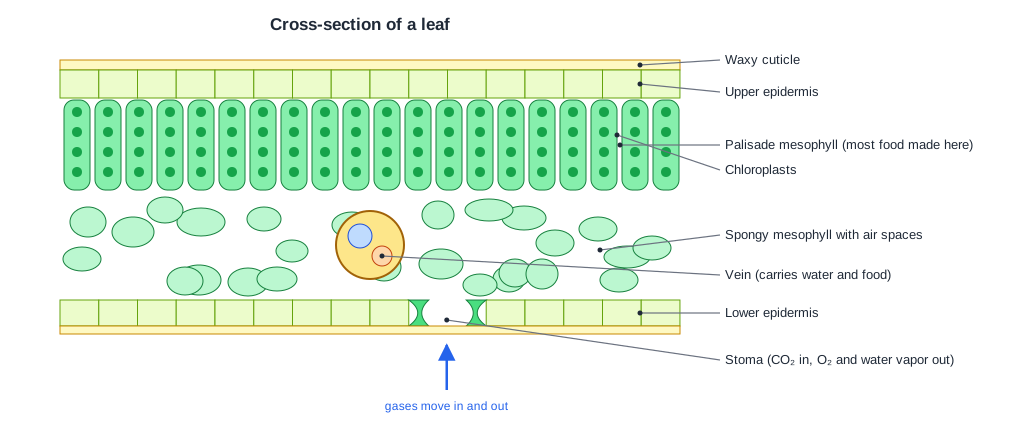
- The top and bottom layers of a leaf are flat epidermal cells, often covered by a waxy cuticle. Small openings on the underside called stomata let carbon dioxide, oxygen, and water vapor pass in and out.葉片的上下表層是扁平的表皮細胞,外面常覆蓋一層蠟質的角質層。葉背上有小開口,稱為氣孔,讓二氧化碳、氧氣和水蒸氣進出。
- Most food is made in mesophyll cells inside the leaf. Tightly packed palisade mesophyll near the top catches the most light; spongy mesophyll has air spaces for gases to move.養分大多在葉子內部的葉肉細胞中製造。靠近上表面、排列緊密的柵狀葉肉細胞接收最多的光;海綿狀葉肉細胞之間有空隙,讓氣體流通。
2Photosynthesis光合作用
AHow photosynthesis works光合作用如何進行
- Photosynthesis is a series of chemical reactions that use light energy to turn carbon dioxide and water into glucose, a sugar, and give off oxygen. It happens in chloroplasts.光合作用是一連串利用光能把二氧化碳和水變成葡萄糖(一種醣)並釋放氧氣的化學反應,發生在葉綠體中。
- First, the green pigment chlorophyll absorbs light energy, which splits water molecules and releases oxygen. Most plants look green because chlorophyll reflects green light.第一步,綠色色素葉綠素吸收光能,把水分子拆開並釋放氧氣。大多數植物看起來是綠色,因為葉綠素會反射綠光。
- Second, the stored energy is used to combine carbon dioxide with hydrogen from water to make glucose. This step can happen without light. Plants use glucose right away or store it, as in potatoes and carrots.第二步,利用儲存的能量把二氧化碳和水中的氫結合,製造葡萄糖。這一步不需要光也能進行。植物會立刻使用葡萄糖,或把它儲存起來,例如馬鈴薯和胡蘿蔔。
注意
6CO₂ + 6H₂O + light energy → C₆H₁₂O₆ + 6O₂6CO₂ + 6H₂O + 光能 → C₆H₁₂O₆ + 6O₂
BLight and the rate of photosynthesis光與光合作用速率
- An Elodea plant under water gives off bubbles of oxygen. Counting bubbles per minute measures how fast photosynthesis is happening.水中的水蘊草會冒出氧氣泡。計算每分鐘冒出的氣泡數,就能測量光合作用進行的速率。
- More light makes more bubbles, so the rate of photosynthesis increases with light intensity. Other conditions, such as temperature, must stay the same for a fair test.光越多,氣泡越多,所以光合作用的速率會隨光照強度增加。為了公平測試,溫度等其他條件必須保持相同。
3Cellular respiration細胞呼吸
AReleasing energy from food從食物中釋放能量
- Cellular respiration is a series of chemical reactions that turn the energy in food molecules into ATP, a form of energy cells can use. Almost all organisms, including plants, do cellular respiration.細胞呼吸是一連串把食物分子中的能量轉換成 ATP(細胞能使用的能量形式)的化學反應。幾乎所有生物,包括植物,都會進行細胞呼吸。
- Step 1, glycolysis, happens in the cytoplasm: glucose is broken into smaller molecules, producing a little ATP.第一步是糖解作用,在細胞質中進行:葡萄糖被分解成較小的分子,產生少量 ATP。
- Step 2 happens in the mitochondria and needs oxygen. The smaller molecules are broken down, releasing large amounts of ATP, plus water and carbon dioxide as waste.第二步在粒線體中進行,需要氧氣。較小的分子被分解,釋放大量 ATP,並產生水和二氧化碳作為廢物。
- Breathing into bromothymol blue turns it yellow, showing that the air you breathe out contains carbon dioxide from cellular respiration.對著溴瑞香草酚藍吹氣,溶液會變黃,表示呼出的氣體含有細胞呼吸產生的二氧化碳。
注意
C₆H₁₂O₆ + 6O₂ → 6CO₂ + 6H₂O + energy (ATP)C₆H₁₂O₆ + 6O₂ → 6CO₂ + 6H₂O + 能量(ATP)
4Two connected processes兩個相連的作用
AComparing photosynthesis and cellular respiration比較光合作用與細胞呼吸
- The products of one process are the reactants of the other. Photosynthesis uses carbon dioxide and water and makes glucose and oxygen; cellular respiration uses glucose and oxygen and makes carbon dioxide and water.一個作用的產物正是另一個作用的反應物。光合作用用掉二氧化碳和水、產生葡萄糖和氧氣;細胞呼吸用掉葡萄糖和氧氣、產生二氧化碳和水。
- Animals only do cellular respiration; plants do both. Without cellular respiration, plants could not grow, reproduce, or repair their tissues.動物只進行細胞呼吸;植物兩者都進行。沒有細胞呼吸,植物就無法生長、繁殖或修補組織。
- Photosynthesis produces most of the oxygen in the atmosphere. Forests also store carbon in trunks, roots, and leaves, so cutting forests releases carbon and adds carbon dioxide to the air.大氣中大部分的氧氣來自光合作用。森林也把碳儲存在樹幹、根和葉中,所以砍伐森林會釋放碳,使空氣中的二氧化碳增加。
Photosynthesis vs. cellular respiration光合作用 vs. 細胞呼吸
| Photosynthesis光合作用 | Cellular respiration細胞呼吸 | |
|---|---|---|
| Where in the cell在細胞的哪裡 | Chloroplasts葉綠體 | Cytoplasm, then mitochondria細胞質,再到粒線體 |
| Which organisms哪些生物 | Plants, algae, some bacteria植物、藻類、部分細菌 | Almost all organisms幾乎所有生物 |
| Reactants反應物 | Carbon dioxide, water, light energy二氧化碳、水、光能 | Glucose, oxygen葡萄糖、氧 |
| Products產物 | Glucose, oxygen葡萄糖、氧 | Carbon dioxide, water, ATP二氧化碳、水、ATP |
| Energy能量 | Stored in glucose儲存在葡萄糖中 | Released as ATP以 ATP 形式釋放 |
自我檢查
Do plants get their food from the soil?植物的養分是從土壤來的嗎?
看答案
No. Plants make their own food (glucose) from carbon dioxide and water using light energy. They take in water and some nutrients from the soil, but the soil is not their food.不是。植物利用光能,把二氧化碳和水製成自己的養分(葡萄糖)。它們從土壤吸收水和一些礦物質,但土壤不是它們的食物。
這課的重點字
- cuticle角質層
- stomata氣孔
- mesophyll葉肉
- photosynthesis光合作用
- chloroplast葉綠體
- chlorophyll葉綠素
- glucose葡萄糖
- cellular respiration細胞呼吸