第 1 單元,第 1 課
Analyzing the Rock and Fossil Records分析岩石與化石紀錄
這課一眼看
Earth is very old地球非常古老
- relative age相對年代: The age of rocks or features compared with others nearby.
- absolute age絕對年代: The numerical age, in years, of a rock or object.
Principles of relative-age dating相對定年的原則
- strata岩層(地層): Layers of sedimentary rock.
- superposition疊置原則: Principle that in undisturbed layers the oldest rocks are on the bottom.
- original horizontality原始水平原則: Principle that most rock-forming materials are deposited in horizontal layers.
- lateral continuity側向連續原則: Principle that sediments are deposited in continuous sheets in all directions.
- inclusions包裹體原則: Principle that a rock containing pieces of another rock is younger than the pieces.
- cross-cutting relationships截切原則: Principle that a feature cutting across rocks is younger than the rocks it cuts.
The fossil record化石紀錄
- mass extinction大滅絕: Extinction of many species within a relatively short time.
1Earth is very old地球非常古老
AUniformitarianism均變說
- Before the late 1700s, most people thought Earth was only a few thousand years old. James Hutton, a Scottish farmer and naturalist, watched streams slowly change the land on his farm and reasoned that the same slow processes could carve canyons and wear down mountains, which would take an enormous amount of time.1700 年代後期以前,大多數人認為地球只有幾千歲。蘇格蘭的農夫兼博物學家赫頓觀察到小溪慢慢改變他農場的地形,推論同樣緩慢的作用也能切出峽谷、磨平山脈,而這需要極長的時間。
- His idea became the principle of uniformitarianism: the geologic processes happening today are similar to those that happened in the past. “The present is the key to the past.” Scientists now know Earth is about 4.6 billion years old.他的想法成為均變說:現在發生的地質作用,和過去發生的作用相似。「現在是了解過去的鑰匙」。科學家現在知道地球約有 46 億歲。
BRelative and absolute age相對年代與絕對年代
- relative age is the age of rocks and features compared with other rocks and features nearby: older or younger. absolute age is the numerical age in years.相對年代是岩石和地質特徵和附近其他岩石、特徵比較出來的年代,也就是誰比較老、誰比較年輕。絕對年代則是以「年」為單位的實際年齡。
- Absolute ages come from radioactive decay: unstable isotopes in rocks change into stable ones at a steady, clock-like rate, so measuring their ratio gives the rock’s age.絕對年代來自放射性衰變:岩石中不穩定的同位素以穩定、像時鐘一樣的速率變成穩定的同位素,測量兩者的比例就能算出岩石的年齡。
2Principles of relative-age dating相對定年的原則
AHow rock layers form岩層如何形成
- Weathering breaks rock into sediment, which gravity, water, and wind carry to low areas and deposit in layers. The weight of new layers compresses older ones into layers of rock called strata.風化把岩石破壞成沉積物,重力、水和風把它帶到低處一層層堆積。新堆上的層次重量壓實下面的舊層,形成一層層的岩層(地層)。
BFive principles五個原則
- superposition: in undisturbed rock layers, the oldest rocks are on the bottom and the youngest on top.疊置原則:在沒有受擾動的岩層中,最老的在底部,最年輕的在頂部。
- original horizontality: most rock-forming materials are deposited in flat, horizontal layers. Tilted or folded layers were disturbed after they formed.原始水平原則:大多數造岩物質沉積時是水平的平層。傾斜或褶皺的岩層,是形成之後才被擾動的。
- lateral continuity: sediments are deposited in large, continuous sheets in all directions, so a layer cut by a canyon continues on the other side.側向連續原則:沉積物會向四面八方鋪成大片連續的層,所以被峽谷切開的岩層,在峽谷另一側會延續下去。
- inclusions: if one rock contains pieces of another rock, the rock containing the pieces is younger than the pieces.包裹體原則:如果一塊岩石包含另一種岩石的碎塊,包著碎塊的岩石比碎塊年輕。
- cross-cutting relationships: if a feature such as a fault or an igneous intrusion cuts across rock layers, the layers it cuts are older than the feature.截切原則:如果斷層或火成岩侵入體等特徵切過岩層,被切的岩層比這個特徵老。
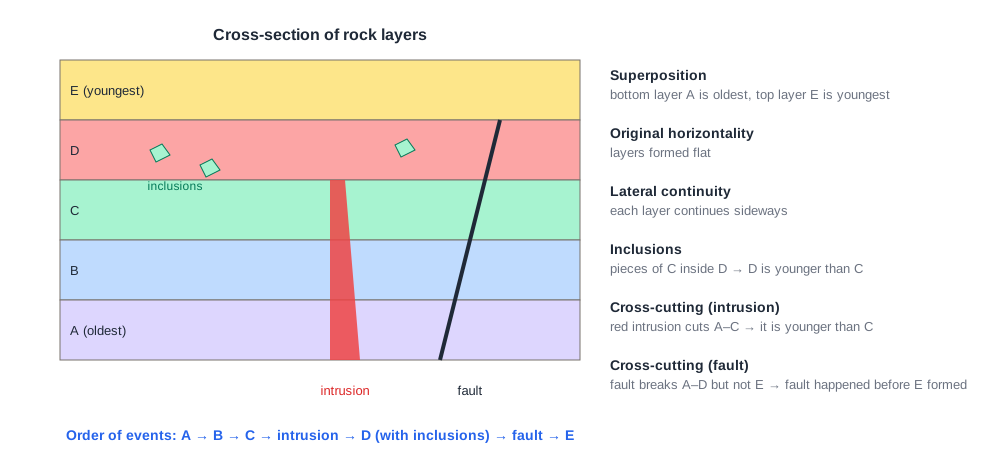
Principles of relative-age dating相對定年的原理
| Principle原理 | Rule規則 |
|---|---|
| Superposition疊置定律 | Undisturbed layers: oldest at bottom, youngest at top未受擾動的地層:最老在下、最新在上 |
| Original horizontality原始水平定律 | Layers are deposited flat; tilting happened later地層沉積時是水平的;傾斜是之後才發生 |
| Lateral continuity側向連續定律 | Layers extend sideways in continuous sheets地層向側面連續延伸成片 |
| Inclusions包裹定律 | Rock containing pieces is younger than the pieces含有碎塊的岩石比碎塊年輕 |
| Cross-cutting relationships截切定律 | A feature is younger than the layers it cuts切穿地層的構造比被切的地層年輕 |
自我檢查
A fault breaks the bottom two layers of a rock sequence but not the top layer. Put the events in order.一個斷層切斷了岩層序列底部的兩層,但沒有切斷最上層。請把事件排序。
看答案
The bottom layer formed, then the middle layer (superposition); next the fault broke both (cross-cutting); finally the top layer was deposited over the fault.先形成最底層,再形成中間層(疊置原則);接著斷層切斷這兩層(截切原則);最後最上層沉積在斷層上方。
3The fossil record化石紀錄
AWhat fossils show化石透露的訊息
- A fossil is the preserved remains or traces of an ancient living thing. Early geologists noticed three patterns in rock layers.化石是古代生物保存下來的遺骸或痕跡。早期地質學家在岩層中注意到三個規律。
- First, the oldest layers hold fossils of simple organisms, and more complex organisms appear in younger layers. Second, at a few levels many kinds of fossils suddenly disappear; these mark a mass extinction, when many species died out in a short time. Third, fossils show what an environment was like: a fossil coral means the area was once a sea.第一,最老的岩層含有簡單生物的化石,較複雜的生物出現在較年輕的岩層。第二,在少數幾個層位,許多種化石突然消失,代表發生大滅絕,也就是許多物種在短時間內滅亡。第三,化石能告訴我們當時的環境:珊瑚化石代表那裡曾經是海。
- For example, trilobite fossils sit in lower layers, dinosaurs and early mammals appear higher, and above a certain level only mammals remain, showing the order in which these groups lived.例如三葉蟲化石在較低的岩層,恐龍和早期哺乳類出現在較高處,再往上只剩下哺乳類,顯示這些生物出現的先後順序。
注意
Seafloor cores contain tiny shells of foraminifera. Their shells hold more “heavy” oxygen during cold, glacial periods, so scientists can use them to read past climates.海床岩芯裡有有孔蟲的微小外殼。冰期時牠們的殼含有較多「重」氧,所以科學家可以用它們推測過去的氣候。
這課的重點字
- relative age相對年代
- absolute age絕對年代
- strata岩層(地層)
- superposition疊置原則
- original horizontality原始水平原則
- lateral continuity側向連續原則
- inclusions包裹體原則
- cross-cutting relationships截切原則