第 1 單元,第 1 課
Position and Motion位置與運動
這課一眼看
Describing position描述位置
- reference point參考點: The starting point chosen to describe the location of an object.
- position位置: An object’s distance and direction from a reference point.
- reference direction參考方向: The direction chosen as positive when describing position.
Describing motion描述運動
- motion運動: A change in position over time.
- displacement位移: The difference between the initial position and the final position.
Speed and velocity速率與速度
- speed速率: Distance an object travels in a given amount of time.
- average speed平均速率: Total distance traveled divided by total time.
- velocity速度: The speed and direction of a moving object.
- vector向量: A quantity that has both magnitude and direction.
- motion diagram運動圖: Series of images or dots showing an object’s position at equal time intervals.
- distance-time graph距離—時間圖: Graph showing how an object’s position changes over time.
1Describing position描述位置
AReference point and direction參考點與方向
- To describe where something is, you need a reference point, the starting point you choose to describe a location. The choice is arbitrary: your friend, your school, or the center of town all work.要描述某物在哪裡,需要一個參考點,也就是你選來描述位置的起點。參考點可以任意選:朋友、學校或市中心都可以。
- An object’s position is its distance and direction from a reference point. A complete description includes all three: a reference point, a distance, and a direction.物體的位置是它相對於參考點的距離和方向。完整的描述要包含三件事:參考點、距離和方向。
- The reference direction is the direction you call positive (+); the opposite direction is negative (−). If east is positive, a museum 80 m east of a bus stop is at +80 m and a library 40 m west is at −40 m.參考方向是你定為正(+)的方向,相反方向就是負(−)。如果以東為正,公車站東邊 80 公尺的博物館位置是 +80 m,西邊 40 公尺的圖書館是 −40 m。
BPosition in two dimensions二維的位置
- In two dimensions you need two reference directions, such as north and east, or left and up. A classmate’s house might be one block south and one block east of yours.在二維平面上需要兩個參考方向,例如北和東,或左和上。同學的家可能在你家往南一個街區、往東一個街區。
- Scientists use SI units, such as the meter, so everyone describes distances the same way.科學家使用國際單位制(SI),例如公尺,讓大家描述距離的方式一致。
2Describing motion描述運動
AMotion is relative運動是相對的
- motion is a change in position over time. Whether something is moving depends on the reference point. A man fishing from a boat does not move relative to his fishing pole, but he moves relative to a floating buoy.運動是位置隨時間改變。物體是否在運動取決於參考點。坐在船上釣魚的人相對於釣竿沒有移動,但相對於浮標是在移動的。
BDistance and displacement距離與位移
- Distance is the total length of the path traveled. displacement is the difference between the starting and final positions: the straight-line distance and direction from start to finish.距離是走過路徑的總長度。位移是起點到終點的位置差,也就是從起點到終點的直線距離和方向。
- A soccer player runs 41.2 m and then 10 m: her distance is 51.2 m, but her displacement may be only 40 m toward the goal. If she ends where she started, her displacement is 0 m.一位足球員先跑 41.2 公尺再跑 10 公尺:她的距離是 51.2 公尺,但位移可能只有朝球門 40 公尺。如果她回到起點,位移就是 0 公尺。
3Speed and velocity速率與速度
ASpeed速率
- speed is the distance an object travels in a given amount of time. Speed can be constant (the same distance each second) or changing.速率是物體在一段時間內移動的距離。速率可以是固定的(每秒走同樣距離),也可以是變化的。
- average speed = total distance ÷ total time. A driver who goes 186 km in 3 hours averages 62 km/h.平均速率 = 總距離 ÷ 總時間。開車 3 小時走 186 公里,平均速率是 62 km/h。
自我檢查
A cyclist rides 30 km in 2 hours, then 45 km in 3 hours. What is her average speed?一位單車騎士 2 小時騎 30 公里,接著 3 小時騎 45 公里。她的平均速率是多少?
看答案
(30 + 45) km ÷ (2 + 3) h = 75 km ÷ 5 h = 15 km/h.(30 + 45) km ÷ (2 + 3) h = 75 km ÷ 5 h = 15 km/h。
BVelocity and vectors速度與向量
- velocity is the speed and direction of a moving object. It is a vector, a quantity with both size (magnitude) and direction, shown with an arrow whose length shows the size.速度是運動物體的速率加上方向。速度是向量,也就是同時有大小和方向的量,用箭頭表示,箭頭長度代表大小。
- Velocity changes if either the speed or the direction changes. A motion diagram shows an object’s position at equal time intervals as dots with velocity arrows.速率或方向只要有一個改變,速度就改變。運動圖用點表示物體在相同時間間隔的位置,並加上速度箭頭。
CDistance-time graphs距離—時間圖
- A distance-time graph shows how an object’s position changes over time. The slope of the line is the speed: a straight line means constant speed, a steeper line means faster, and a flat line means the object is not moving.距離—時間圖顯示物體的位置如何隨時間改變。線的斜率就是速率:直線代表等速,越陡代表越快,水平線代表物體靜止。
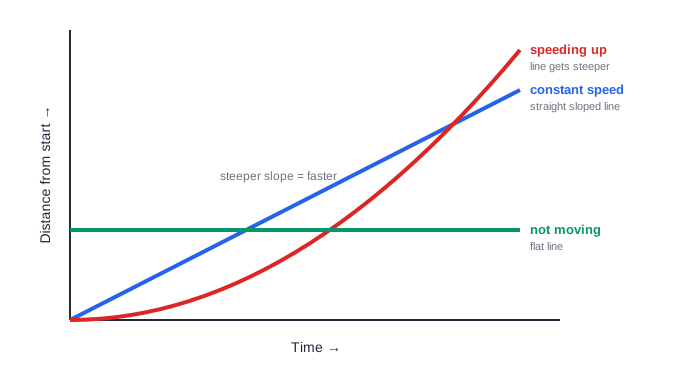
Reading a distance-time graph判讀距離-時間圖
| Line shape線的形狀 | Meaning意義 |
|---|---|
| Straight, rising直線上升 | Constant speed等速 |
| Steeper較陡 | Faster較快 |
| Flat (horizontal)平的(水平) | Not moving靜止 |
| Curving upward向上彎曲 | Speeding up加速 |
| Curving toward flat彎向水平 | Slowing down減速 |
注意
GPS uses at least 24 satellites as reference points to find a location on Earth, which is how a GPS pet collar can locate a lost dog.GPS 以至少 24 顆衛星作為參考點來定位地球上的位置,所以裝了 GPS 的寵物項圈能找到走失的狗。
這課的重點字
- reference point參考點
- position位置
- reference direction參考方向
- motion運動
- displacement位移
- speed速率
- average speed平均速率
- velocity速度