第 1 單元,第 1 課
Wave Properties波的性質
這課一眼看
What a wave is什麼是波
- wave波: Disturbance that transfers energy without transferring matter.
- vibration振動: A back-and-forth or up-and-down movement.
- mechanical wave力學波: Wave that travels only through matter.
- medium介質: Material through which a wave travels.
- transverse wave橫波: Wave in which the disturbance is perpendicular to the wave’s direction.
- crest波峰: Highest point of a transverse wave.
- trough波谷: Lowest point of a transverse wave.
- longitudinal wave縱波: Wave in which particles move parallel to the wave’s direction.
- compression密部: Region of a longitudinal wave where particles are closest together.
- rarefaction疏部: Region of a longitudinal wave where particles are farthest apart.
- sound wave聲波: Longitudinal wave that travels only through matter.
Amplitude and energy振幅與能量
- amplitude振幅: Maximum distance a wave moves from its rest position.
- loudness響度: How you perceive the energy of a sound wave.
- intensity強度: Amount of energy passing through a square meter each second.
- decibel分貝: Unit used to describe sound intensity and loudness.
Wavelength and frequency波長與頻率
- wavelength波長: Distance from one point on a wave to the same point on the next wave.
- frequency頻率: Number of wavelengths that pass a point each second.
- hertz赫茲: Unit of frequency; one wave per second.
- pitch音調: How high or low a sound seems.
- ultrasound超聲波(超音波): Sound with frequencies above human hearing (above 20,000 Hz).
1What a wave is什麼是波
AWaves carry energy, not matter波傳遞能量,不傳遞物質
- A wave is a disturbance that transfers energy from one place to another without transferring matter. A ball floating in the ocean bobs up and down as waves pass but is not carried to shore by them.波是一種擾動,把能量從一處傳到另一處,但不傳遞物質。漂在海上的球會隨波上下起伏,但不會被波帶到岸邊。
- Every wave has an energy source, a vibration: a back-and-forth or up-and-down movement, such as a vibrating drum or guitar string. Waves keep traveling even after the source stops vibrating.每個波都有能量來源,也就是振動:來回或上下的運動,例如振動的鼓面或吉他弦。振源停止後,已產生的波仍會繼續前進。
BMechanical waves力學波
- A mechanical wave travels only through matter: solids, liquids, or gases, but not a vacuum. The material a wave travels through is its medium.力學波只能在物質中傳播,包括固體、液體或氣體,但不能在真空中傳播。波傳播所經過的物質稱為介質。
- In a transverse wave, the disturbance is perpendicular to the direction the wave travels, like a rope shaken up and down. The high points are crests and the low points are troughs.橫波的擾動方向和波前進的方向垂直,就像上下甩動的繩子。最高點稱為波峰,最低點稱為波谷。
- In a longitudinal wave, particles move parallel to the direction the wave travels. Regions where particles are squeezed together are compressions; regions where they are spread apart are rarefactions.縱波的粒子運動方向和波前進的方向平行。粒子擠在一起的區域稱為密部,粒子分開的區域稱為疏部。
- A sound wave is a longitudinal wave that travels only through matter. A speaker cone pushes air particles together (compression, high pressure) and then leaves a gap (rarefaction, low pressure).聲波是只能在物質中傳播的縱波。喇叭紙盆往前推,把空氣粒子擠在一起(密部、高壓),往後退時留下空隙(疏部、低壓)。
- Water waves combine both types: water particles move in circles that get smaller as the wave nears land. Earthquakes send out seismic waves; P-waves are longitudinal, S-waves are transverse, and S-waves cannot pass through Earth’s liquid outer core.水波是兩種波的組合:水粒子做圓周運動,靠近陸地時圓圈變小。地震會發出地震波;P 波是縱波,S 波是橫波,S 波無法通過地球的液態外核。
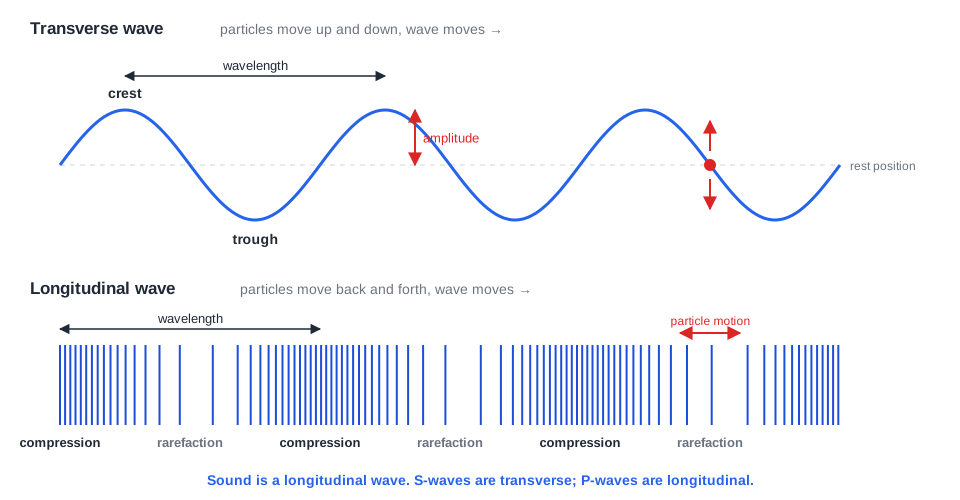
Types of mechanical waves力學波的類型
| Wave波 | Particle motion vs. wave direction粒子運動與波行進方向 | Parts構造 | Examples例子 |
|---|---|---|---|
| Transverse橫波 | Perpendicular垂直 | Crests, troughs波峰、波谷 | Rope wave, S-waves繩波、S 波 |
| Longitudinal縱波 | Parallel平行 | Compressions, rarefactions密部、疏部 | Sound, spring push, P-waves聲波、推彈簧、P 波 |
| Water / surface水波/表面波 | Circular (both)圓周(兩者皆有) | Crests, troughs波峰、波谷 | Ocean waves, seismic surface waves海浪、地震表面波 |
2Amplitude and energy振幅與能量
AAmplitude振幅
- The amplitude of a wave is the maximum distance it moves from its rest position. For a longitudinal wave, a larger amplitude means particles are packed more tightly in compressions and spread more in rarefactions.波的振幅是波離開平衡位置的最大距離。對縱波來說,振幅越大,密部的粒子擠得越緊,疏部的粒子分得越開。
- More energy makes a bigger amplitude. Wave energy is proportional to the amplitude squared: double the amplitude and the wave carries four times the energy.能量越大,振幅越大。波的能量和振幅的平方成正比:振幅加倍,波帶的能量變成 4 倍。
BLoudness and intensity響度與強度
- loudness is how you perceive the energy of a sound wave. intensity is the amount of sound energy passing through a square meter each second. As sound spreads from its source, its energy is shared by more air particles, so intensity, amplitude, and loudness decrease with distance.響度是你對聲波能量的感受。強度是每秒通過每平方公尺的聲能。聲音從聲源傳開時,能量分散給更多空氣粒子,所以強度、振幅和響度都隨距離減小。
- Sound intensity is measured in decibels (dB). Each 10 dB increase means about 10 times the energy and sounds about twice as loud. Sounds above about 85 dB can damage hearing over time.聲音強度以分貝(dB)為單位。每增加 10 dB,能量約變成 10 倍,聽起來約大聲 2 倍。超過約 85 dB 的聲音聽久了會損害聽力。
注意
A tsunami’s amplitude grows and its wavelength shrinks as it reaches shallow water. Often the trough arrives first, so the sea pulls far back from shore, a natural warning sign.海嘯進入淺水區時振幅變大、波長變短。通常波谷先到,海水會大幅退離岸邊,這是自然的警訊。
3Wavelength and frequency波長與頻率
AWavelength and frequency波長與頻率
- wavelength is the distance from one point on a wave to the same point on the next wave: crest to crest, or compression to compression. It is measured in meters.波長是波上某一點到下一個波相同點的距離:波峰到波峰,或密部到密部。單位是公尺。
- frequency is the number of wavelengths that pass a point each second. It equals the number of vibrations per second of the source and is measured in hertz (Hz); 2 Hz means two wavelengths pass each second.頻率是每秒通過某一點的波數,等於振源每秒振動的次數,單位是赫茲(Hz);2 Hz 代表每秒有兩個波通過。
- For waves in the same medium, higher frequency means shorter wavelength. Energy delivered in a given time is proportional to frequency.在同一介質中,頻率越高,波長越短。一段時間內傳遞的能量和頻率成正比。
自我檢查
One complete wave passes a point every 4 seconds. What is the frequency?每 4 秒有一個完整的波通過某點。頻率是多少?
看答案
1 wave ÷ 4 s = 0.25 Hz.1 個波 ÷ 4 秒 = 0.25 Hz。
BPitch音調
- pitch is how high or low a sound seems, and it depends on frequency: higher frequency, higher pitch. A shorter or tighter string vibrates faster and gives a higher pitch.音調是聲音聽起來的高低,取決於頻率:頻率越高,音調越高。較短或較緊的弦振動較快,音調較高。
- Humans hear about 20 Hz to 20,000 Hz. Sounds above this range are ultrasound. Adult male voices are roughly 85–155 Hz; female voices about 165–255 Hz.人耳能聽到約 20 Hz 到 20,000 Hz 的聲音,高於這個範圍的稱為超聲波(超音波)。成年男性的聲音約 85~155 Hz,女性約 165~255 Hz。
Wave properties and what you sense波的性質與感受
| Property性質 | Definition定義 | Unit單位 | For sound, you hear聲音聽起來是 |
|---|---|---|---|
| Amplitude振幅 | Maximum distance from rest position離開平衡位置的最大距離 | mm | Loudness響度 |
| Wavelength波長 | Distance from crest to crest波峰到波峰的距離 | mm | —— |
| Frequency頻率 | Waves passing per second每秒通過的波數 | HzHz | Pitch音調 |
| Energy能量 | Grows with amplitude² (mechanical waves)隨振幅平方增加(力學波) | JJ | Louder = more energy越大聲=能量越大 |
注意
A cochlear implant uses a microphone, a speech processor, and electrodes in the cochlea to send electrical signals to the hearing nerve when the ear’s hair cells are damaged.人工電子耳以麥克風、語音處理器和植入耳蝸的電極,在毛細胞受損時把電訊號直接傳給聽神經。
這課的重點字
- wave波
- vibration振動
- mechanical wave力學波
- medium介質
- transverse wave橫波
- crest波峰
- trough波谷
- longitudinal wave縱波