第 2 單元,第 4 課
Molecular Structure分子結構
這課一眼看
Structures of elements元素的結構
- molecule分子: Atoms bonded together that act as one unit.
- diatomic molecule雙原子分子: Molecule of two identical atoms.
- extended structure延伸結構: Many atoms joined in a repeating pattern.
- metal金屬: Shiny, malleable element that conducts well.
- nonmetal非金屬: Element that is usually dull or a gas and conducts poorly.
- malleable有延展性的: Can be hammered or bent without breaking.
- brittle易碎的: Breaks or shatters easily.
- conductor導體: Material that carries electricity or heat well.
Structures of compounds化合物的結構
- ionic compound離子化合物: Compound of oppositely charged atoms in an extended structure.
- covalent compound共價化合物: Compound made of molecules.
- polar極性的: Molecules attract each other fairly strongly.
- nonpolar非極性的: Molecules attract each other only weakly.
- dissolve溶解: Mix evenly into another substance.
Structure decides properties結構決定性質
- crystal晶體: Solid with a repeating pattern of particles.
- graphite石墨: Carbon in sliding sheets; soft.
- diamond鑽石: Carbon in a rigid network; very hard.
1Structures of elements元素的結構
AAtoms, molecules, and extended structures原子、分子與延伸結構
- Elements can have three kinds of structures. Some, like helium and neon, exist as individual atoms that are not attracted to each other.元素有三種結構。有些元素(如氦、氖)以單獨的原子存在,原子之間不互相吸引。
- Some exist as molecules: groups of atoms held together by chemical bonds that act as one unit. Hydrogen (H₂), oxygen (O₂), and nitrogen (N₂) are diatomic molecules, made of two of the same atom.有些元素以分子的形式存在:分子是由化學鍵結合在一起、作為一個單位的一群原子。氫(H₂)、氧(O₂)、氮(N₂)是雙原子分子,由兩個相同的原子組成。
- Some are made of many atoms of the same type connected in a repeating pattern called an extended structure, such as copper and other metals.還有些元素由大量同種原子以重複的方式連接而成,稱為延伸結構,例如銅和其他金屬。
BProperties of metals and nonmetals金屬與非金屬的性質
- Metals form extended structures with strong attractions between atoms. Most are shiny solids at room temperature, have high melting and boiling points, and are good conductors of electricity and thermal energy.金屬形成原子間吸引力很強的延伸結構。大多數金屬在室溫下是有光澤的固體,熔點和沸點都很高,是電和熱的良導體。
- Metals are malleable: their atoms can slide past one another, so metals bend or flatten when hammered instead of breaking.金屬具有延展性:原子可以彼此滑動,所以金屬被敲打時會彎曲或變扁,而不會碎裂。
- Many nonmetals are gases at room temperature, made of single atoms or small molecules with weak attractions between them, so they boil at very low temperatures and do not conduct well. Nonmetal solids, such as sulfur, are dull, brittle, and poor conductors.許多非金屬在室溫下是氣體,由單獨原子或小分子組成,粒子間吸引力弱,所以沸點很低,也不容易導電導熱。非金屬固體(如硫)沒有光澤、易碎,是不良導體。
Metals vs. nonmetals金屬 vs. 非金屬
| Metals金屬 | Nonmetal gases非金屬氣體 | Nonmetal solids非金屬固體 | |
|---|---|---|---|
| Structure結構 | Extended structure延展結構 | Single atoms or small molecules單一原子或小分子 | Atoms joined, weak attractions原子相連,吸引力弱 |
| Appearance外觀 | Shiny有光澤 | —— | Dull暗淡 |
| Hit with hammer用槌子敲 | Bends (malleable)彎曲(延展性) | —— | Shatters (brittle)碎裂(脆) |
| Conducts electricity/heat導電導熱 | Well良好 | Poorly差 | Poorly差 |
| Melting / boiling point熔點/沸點 | High高 | Very low非常低 | Low低 |
| Examples例子 | Copper, iron, gold銅、鐵、金 | Helium, oxygen, nitrogen氦、氧、氮 | Sulfur, carbon硫、碳 |
2Structures of compounds化合物的結構
AIonic compounds離子化合物
- An ionic compound forms between atoms with opposite charges, usually a metal and a nonmetal. The strong attraction between the charged atoms builds an extended structure with a repeating pattern, such as table salt (sodium chloride, NaCl).離子化合物由帶相反電荷的原子組成,通常是金屬和非金屬。帶電原子之間的強大吸引力形成重複排列的延伸結構,例如食鹽(氯化鈉,NaCl)。
- Because the attractions are strong, ionic compounds have high melting and boiling points. They are brittle: a hard hit separates the atoms along a line and the solid shatters.因為吸引力很強,離子化合物的熔點和沸點都很高。它們很脆:受到重擊時,原子會沿著一條線分開,固體就碎裂了。
- Many ionic compounds dissolve in water. The water solution conducts electricity because the charged atoms can move through it.許多離子化合物可以溶於水。這種水溶液能導電,因為帶電的原子可以在溶液中移動。
BCovalent compounds: polar and nonpolar共價化合物:極性與非極性
- A covalent compound is made of molecules. Covalent compounds usually have low melting and boiling points, so many are liquids or gases at room temperature, and they are poor conductors.共價化合物由分子組成。共價化合物的熔點和沸點通常較低,所以許多在室溫下是液體或氣體,而且導電性差。
- In a polar covalent compound, such as water or sugar (C₁₂H₂₂O₁₁), the molecules attract each other fairly strongly. Sugar molecules can even pack into crystals.在極性共價化合物中(例如水或糖 C₁₂H₂₂O₁₁),分子之間的吸引力相當強。糖分子甚至可以排列成晶體。
- In a nonpolar covalent compound, such as carbon dioxide or oil, the molecules attract each other only weakly, so the melting and boiling points are very low.在非極性共價化合物中(例如二氧化碳或油),分子之間的吸引力很弱,所以熔點和沸點非常低。
- "Like dissolves like": polar substances dissolve in polar substances, and nonpolar substances dissolve in nonpolar substances. That is why sugar dissolves in water but oil does not.「相似者相溶」:極性物質溶於極性物質,非極性物質溶於非極性物質。這就是糖能溶於水、油卻不能的原因。
Types of compounds化合物的類型
| Ionic離子化合物 | Polar covalent極性共價化合物 | Nonpolar covalent非極性共價化合物 | |
|---|---|---|---|
| Made of組成 | Metal + nonmetal, opposite charges金屬+非金屬,帶相反電荷 | Molecules分子 | Molecules分子 |
| Attraction between particles粒子間吸引力 | Very strong非常強 | Fairly strong相當強 | Weak弱 |
| Melting / boiling point熔點/沸點 | High高 | Medium中等 | Very low非常低 |
| Dissolves in water?溶於水嗎? | Many do很多會 | Yes會 | No不會 |
| Conducts in water?水溶液導電嗎? | Yes會 | No不會 | No不會 |
| Example例子 | Table salt (NaCl)食鹽(NaCl) | Sugar, water糖、水 | Oil, carbon dioxide油、二氧化碳 |
3Structure decides properties結構決定性質
ACrystals and forms of carbon晶體與碳的不同形式
- A crystal is a solid whose particles form a repeating pattern. Metals, ionic compounds, and some covalent compounds can all form crystals, and the crystal’s shape (cube, needle, sheet) reflects how its atoms are arranged.晶體是粒子以重複規律排列的固體。金屬、離子化合物和某些共價化合物都能形成晶體,晶體的形狀(立方體、針狀、片狀)反映出原子的排列方式。
- Carbon shows how structure controls properties. In graphite, carbon atoms form flat sheets that slide easily past each other, so graphite is soft and slippery. In diamond, every carbon atom is linked tightly to its neighbors in a rigid network, making diamond extremely hard. Graphite is also a famous exception among nonmetals: unlike most nonmetal solids, it conducts electricity well.碳說明了結構如何決定性質。石墨中的碳原子形成平面層,層與層容易滑動,所以石墨柔軟滑順。鑽石中的每個碳原子都和鄰近原子緊密連接成堅固的網狀結構,所以鑽石非常堅硬。石墨也是非金屬中著名的例外:和多數非金屬固體不同,它導電性良好。
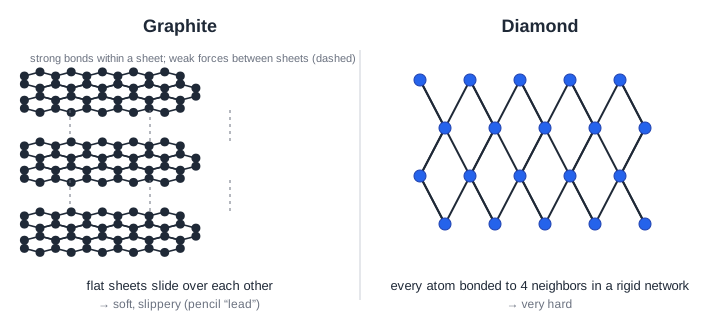
- Amorphous carbon, found in soot and charcoal, has no orderly arrangement of atoms.非晶形碳存在於煤灰和木炭中,碳原子沒有規則的排列。
這課的重點字
- molecule分子
- diatomic molecule雙原子分子
- extended structure延伸結構
- metal金屬
- nonmetal非金屬
- malleable有延展性的
- brittle易碎的
- conductor導體