第 3 單元,第 1 課
Inheritance遺傳
這課一眼看
Traits and heredity特徵與遺傳
- trait特徵: A characteristic of an organism, such as eye color.
- phenotype表現型: How a trait appears or is expressed.
- heredity遺傳: The passing of traits from parents to offspring.
Mendel’s experiments孟德爾的實驗
- genetics遺傳學: The study of how traits are passed from parents to offspring.
- dominant trait顯性特徵: A genetic factor that blocks another genetic factor.
- recessive trait隱性特徵: A genetic factor that is blocked when a dominant factor is present.
Genes and alleles基因與對偶基因
- chromosome染色體: Threadlike structure in the nucleus that carries genetic information.
- gene基因: Section of a chromosome with genetic information for one trait.
- allele對偶基因: One of the different forms of a gene.
- genotype基因型: The two alleles that control the phenotype of a trait.
- homozygous同型合子: Having two identical alleles for a gene.
- heterozygous異型合子: Having two different alleles for a gene.
Predicting offspring預測子代
- Punnett square棋盤方格(龐尼特方格): Model used to predict possible genotypes and phenotypes of offspring.
- pedigree系譜圖: Chart showing the phenotypes of related family members.
1Traits and heredity特徵與遺傳
AWhat traits are什麼是特徵
- A trait is a characteristic, such as hair color, height, or whether your earlobes are attached. How a trait actually shows up is its phenotype.特徵是指一種性狀,例如髮色、身高或耳垂是否分離。特徵實際表現出來的樣子稱為表現型。
- Some traits, such as eye color, come in many forms. Others come in only two, such as curved or straight thumbs.有些特徵(例如眼睛顏色)有很多種表現;有些只有兩種,例如拇指彎曲或筆直。
- heredity is the passing of traits from parents to offspring. It can be surprising: a child can have straight thumbs even when both parents have curved thumbs.遺傳是指特徵從親代傳給子代。結果有時令人意外:父母拇指都是彎的,孩子卻可能是直的。
2Mendel’s experiments孟德爾的實驗
ATrue-breeding and hybrid plants純種與雜種植物
- More than 150 years ago, Gregor Mendel, an Austrian monk, did controlled breeding experiments with pea plants. He is called the father of genetics, the study of how traits pass from parents to offspring.一百五十多年前,奧地利修士孟德爾用豌豆做了控制條件的育種實驗。他被稱為遺傳學之父;遺傳學研究特徵如何從親代傳給子代。
- He started with true-breeding plants: when they pollinate themselves, the offspring always match the parent. Crossing true-breeding purple-flowered plants with true-breeding white-flowered plants gave only purple offspring, not light purple.他從純種植物開始:純種植物自花授粉,子代一定和親代一樣。把純種紫花和純種白花雜交,子代全部開紫花,而不是淡紫色。
- These first-generation purple plants are hybrids: their parents had different forms of the same trait. When Mendel crossed two hybrids, the white flowers came back in the second generation.這些第一代紫花植物是雜種,因為它們的親代對同一個特徵有不同的表現。孟德爾把兩株雜種互相雜交,白花在第二代又出現了。
BThe 3 : 1 pattern3 : 1 的規律
- Mendel counted thousands of offspring from hybrid crosses. For every trait he tested, the ratio was about 3 : 1. For example, 705 purple to 224 white flowers is about 3.15 : 1, and 6,022 yellow to 2,001 green seeds is about 3.01 : 1.孟德爾計算了數千株雜種雜交的子代。他測試的每一個特徵,比例都大約是 3 : 1。例如紫花 705 株、白花 224 株,約 3.15 : 1;黃色種子 6,022 顆、綠色 2,001 顆,約 3.01 : 1。
Mendel’s hybrid crosses孟德爾的雜交實驗
| Trait性狀 | Dominant form (count)顯性(數量) | Recessive form (count)隱性(數量) | Ratio比例 |
|---|---|---|---|
| Flower color花色 | Purple (705)紫(705) | White (224)白(224) | 3.15 : 13.15 : 1 |
| Seed color種子顏色 | Yellow (6,022)黃(6,022) | Green (2,001)綠(2,001) | 3.01 : 13.01 : 1 |
| Seed shape種子形狀 | Round (5,474)圓(5,474) | Wrinkled (1,850)皺(1,850) | 2.96 : 12.96 : 1 |
| Pod shape豆莢形狀 | Smooth (882)平滑(882) | Bumpy (299)凹凸(299) | 2.95 : 12.95 : 1 |
CDominant and recessive顯性與隱性
- Mendel proposed that each plant has two genetic factors for a trait, one from each parent. A dominant trait is a factor that blocks another factor. A recessive trait is blocked when a dominant factor is present.孟德爾提出每株植物對一個特徵有兩個遺傳因子,分別來自父母。顯性特徵是會遮蓋另一個因子的因子;隱性特徵則在有顯性因子時被遮蓋。
- A dominant trait shows up when an offspring has one or two dominant factors. A recessive trait shows up only when two recessive factors are present.子代只要有一個或兩個顯性因子,就會表現顯性特徵;必須兩個都是隱性因子,才會表現隱性特徵。
3Genes and alleles基因與對偶基因
AChromosomes, genes, and alleles染色體、基因與對偶基因
- Mendel’s “factors” are found on chromosomes, threadlike structures in the nucleus. Chromosomes come in pairs, one from each parent.孟德爾所說的「因子」位於染色體上;染色體是細胞核中的線狀構造,成對存在,一條來自父親、一條來自母親。
- A gene is a section of a chromosome with genetic information for one trait. The different forms of a gene are called alleles. The two alleles that control a trait make up its genotype.基因是染色體上帶有某一個特徵遺傳資訊的片段。同一個基因的不同形式稱為對偶基因。控制一個特徵的兩個對偶基因組成它的基因型。
- Uppercase letters stand for dominant alleles and lowercase letters for recessive ones. If the two alleles are the same (RR or rr), the genotype is homozygous. If they differ (Rr), it is heterozygous.大寫字母代表顯性對偶基因,小寫字母代表隱性對偶基因。兩個對偶基因相同(RR 或 rr)稱為同型合子;不同(Rr)稱為異型合子。
Phenotype and genotype (seed shape)表現型與基因型(種子形狀)
| Phenotype表現型 | Genotype基因型 | Type類型 |
|---|---|---|
| Round圓 | RRRR | Homozygous dominant同型合子顯性 |
| Round圓 | RrRr | Heterozygous異型合子 |
| Wrinkled皺 | rrrr | Homozygous recessive同型合子隱性 |
自我檢查
A pea plant has wrinkled seeds. What is its genotype, and why?一株豌豆的種子是皺的。它的基因型是什麼?為什麼?
看答案
rr. Wrinkled is recessive, so it shows only when both alleles are recessive.rr。皺種子是隱性特徵,只有兩個對偶基因都是隱性時才會表現。
4Predicting offspring預測子代
AProbability and ratios機率與比例
- Like a coin toss, each offspring is a separate event. A 3 : 1 ratio means each seed has a 3-in-4 chance of being yellow; it does not mean every group of four seeds will have exactly three yellow.就像擲硬幣,每一個子代都是獨立事件。3 : 1 代表每顆種子有四分之三的機率是黃色,不代表每四顆種子一定剛好三顆黃色。
BPunnett squares棋盤方格法
- A Punnett square is a model that predicts the possible genotypes and phenotypes of offspring when the parents’ genotypes are known.棋盤方格(龐尼特方格)是已知親代基因型時,用來預測子代可能基因型和表現型的模型。
- Put one parent’s alleles across the top and the other’s down the side, then fill each box with one allele from each. For Yy × Yy, the boxes are YY, Yy, Yy, yy: a genotype ratio of 1 : 2 : 1 and a phenotype ratio of 3 yellow : 1 green.把一方親代的對偶基因寫在上方,另一方寫在左側,每一格填入兩邊各一個對偶基因。Yy × Yy 的四格是 YY、Yy、Yy、yy:基因型比例 1 : 2 : 1,表現型比例 3 黃 : 1 綠。
- For CC × cc, every box is Cc, so all offspring show the dominant trait. Switching which parent goes on top does not change the result.CC × cc 的每一格都是 Cc,所以子代全部表現顯性特徵。把兩個親代上下對調,結果也不會改變。
Punnett square: Yy × Yy棋盤方格:Yy × Yy
| YY | yy | |
|---|---|---|
| YY | YY (yellow)YY(黃) | Yy (yellow)Yy(黃) |
| yy | Yy (yellow)Yy(黃) | yy (green)yy(綠) |
CPedigrees系譜圖
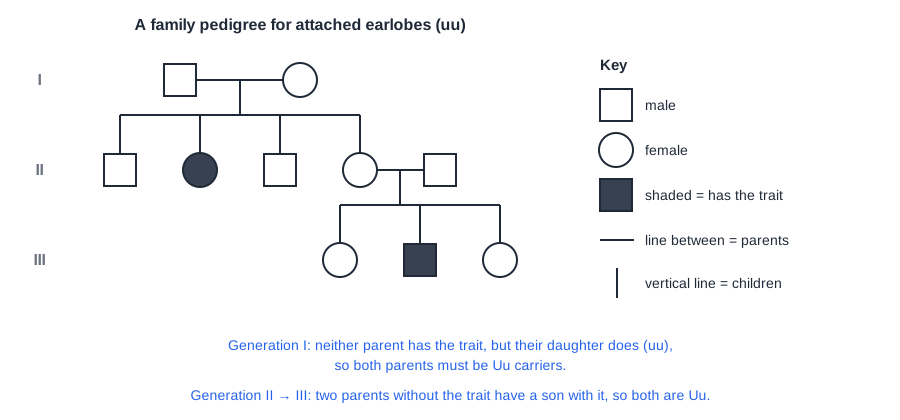
- A pedigree shows the phenotypes of related family members across generations and can help work out genotypes. Circles are females, squares are males, and shaded shapes show the trait being studied.系譜圖顯示一個家族好幾代成員的表現型,可以幫助推算基因型。圓形代表女性,方形代表男性,塗色的圖形代表具有所研究的特徵。
- If two parents with unattached earlobes have a child with attached earlobes (uu), each parent must carry one recessive allele, so both are Uu.如果耳垂分離的父母生下耳垂相連(uu)的孩子,父母一定各帶有一個隱性對偶基因,所以兩人都是 Uu。
注意
Genetic counselors use family histories, pedigrees, and DNA tests to tell families their risk of inherited disorders such as cystic fibrosis.遺傳諮詢師利用家族病史、系譜圖和 DNA 檢測,告訴家庭罹患囊腫性纖維化等遺傳疾病的風險。
這課的重點字
- trait特徵
- phenotype表現型
- heredity遺傳
- genetics遺傳學
- dominant trait顯性特徵
- recessive trait隱性特徵
- chromosome染色體
- gene基因